


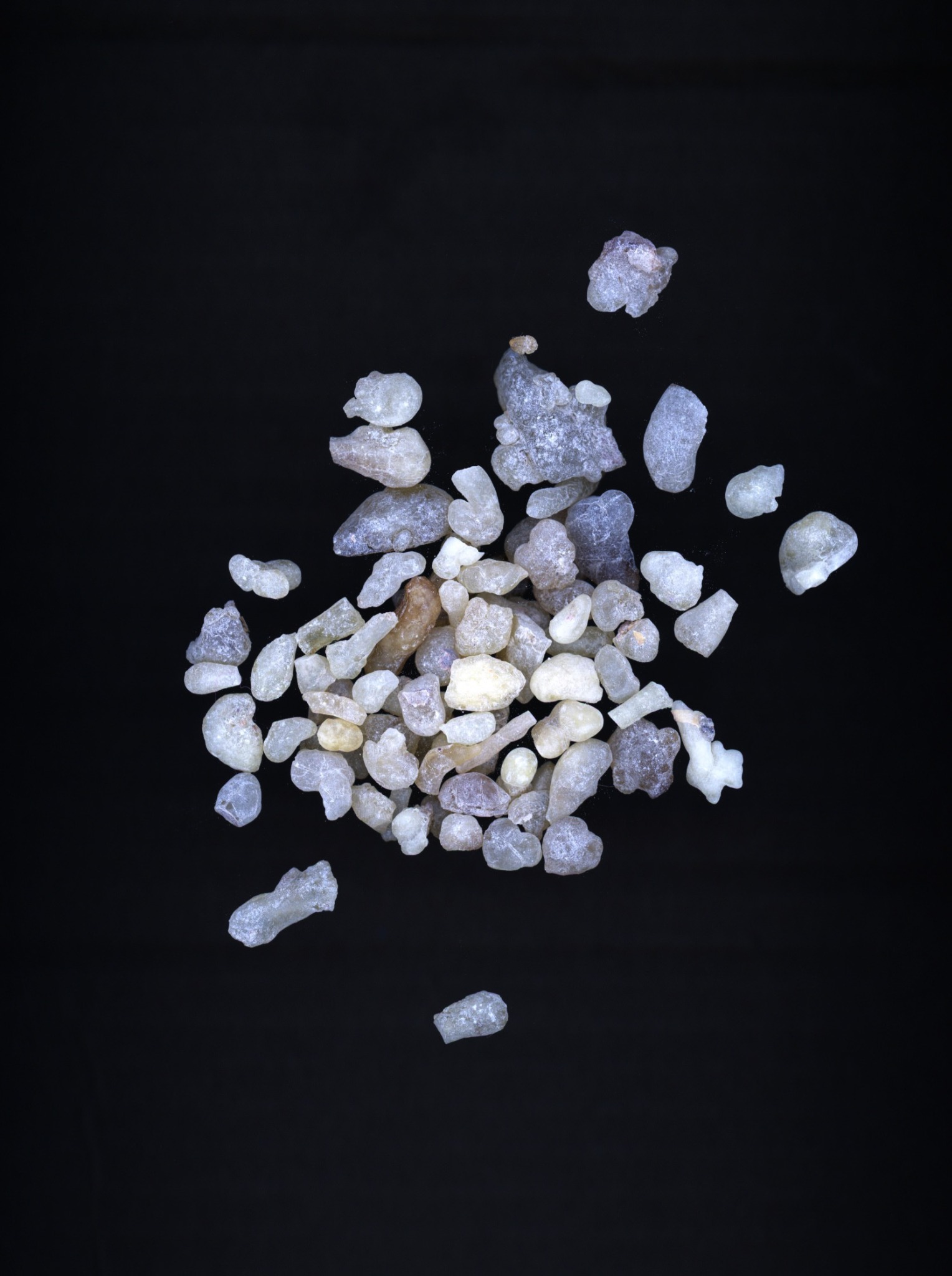
Frankincense resin, Boswellia sacra. Studio scan by Blair Butterfield.
Frankincense
Boswellia sacra
In the story of the Magi, frankincense is laid beside gold and myrrh. In church, it rises from the censer, its smoke lingering in the stone and cloth long after the service ends. These small tears of resin have been traded for millennia. The distilled oil is sometimes called the king of essential oils. To me, it feels most luxurious in the quiet of a warm bath, when the scent rises with the steam.
In the studio I keep two frankincense specimens. One is a single rough piece, grey and deeply creased. The other, Boswellia carteri, comes as loose, pale tears. I scanned them against black to show the resin before it becomes smoke or oil.
Family
Burseraceae
Part used
Gum-resin
Native to
The Horn of Africa and southern Arabian Peninsula [7, 9]
Principal preparation
Resin and aromatic oil
Our oil
Distilled frankincense essential oil from FairSource Botanicals [9]
What it smells like
Bright and piney at first, with a lift of citrus and a soft resinous finish.
Why we work with it
I reach for frankincense when I want the brightness of citrus and the depth of resin. In a warm bath, its scent rises with the steam and settles into the room. I work with it for energetic protection, and when I’m making a ritual for meditation or want to feel closer to my higher self. In skin oils, I reach for it for the toned, refined feel I want the blend to leave on the skin.
A Colour Study of Frankincense
Boswellia sacra
Family
Burseraceae
Family
Burseraceae
Family
Burseraceae
Family
Burseraceae
Family
Burseraceae
Family
Burseraceae
Family
Burseraceae

Resin Face Grey
Sampled from the lit faces of the sacra resin.
Sacra Ash
Sampled from the body of the sacra piece.
Seam Amber
The warmest tone in the sacra piece, deep in its creases.
Pale Tear
Sampled from the brightest carteri tears.
Find Frankincense In
Skin Potion No. 1
Facial oil · 4 oz
Ritual Body Oil
Body oil · 16 oz
Frankincense & Myrrh Bath Drops
Bath oil · 2 oz
Dragon’s Blood Balm
Balm · 2 oz
The Longer Portrait
Botanical identity
Frankincense is the aromatic resin of several trees in the genus Boswellia. In the studio I work with two frankincense materials, Boswellia sacra and Boswellia carteri. I keep them distinct in my notes. The oils smell markedly different to me.
Chemistry and research
Whole resin, distilled oil, and resin extracts are different preparations. Clinical studies summarized by the U.S. National Center for Complementary and Integrative Health focus mainly on Boswellia serrata preparations [6]. Those studies offer context for the wider genus. The material featured here is Boswellia sacra resin and its distilled essential oil.
Ethnobotany and history
The gift and the smoke
In Matthew’s account of the Magi, frankincense is laid beside gold and myrrh [1]. In Exodus, it is blended into sacred incense [2]. Ovid tells a different story in Book IV of the Metamorphoses. The sun god pours nectar over the buried Leucothoe, and a frankincense tree takes root at her grave [3].
From grove to port
In Dhofar, Oman, the trees at Wadi Dawkah, the caravan oasis at Shisr, and the ports of Khor Rori and Al-Baleed trace the passage of resin from the grove to the sea [4].
Resin in daily life
The resin has long been burned for its scent. A CITES review also records a tradition in Yemen of chewing maydi for breath and oral care. Maydi comes from Boswellia frereana, another frankincense tree [5].
Harvest and extraction
The trees a family knows
In parts of Somaliland, families have harvested frankincense from the same groves for generations. Knowing a tree means knowing where to cut, how much resin to take, and when to leave it alone. Conflict and displacement have separated some families from the groves they tended. Where hired harvesters are paid by the weight of the resin, there can be pressure to take as much as possible in one season. Repeated deep cuts and damage to the bark can weaken a tree and eventually kill it. [8]
I buy my frankincense oil from FairSource Botanicals. They work with local harvesters to support fair pay, monitor the trees, and give tapped trees time to rest. That rest matters to me. These are sacred trees, and their care is part of what I value when I bring frankincense into the studio. [9]
Burseraceae
Family
Burseraceae
Field Note
Pale frankincense tears, Boswellia carteri. Studio scan by Blair Butterfield.
Show the preparations +
Alcohol maceration [11]
Oil infusion [12]
Distillation of the resin [9]
Whole resin, burned as incense [2, 5]
Image credits
Resin scans by Blair Butterfield. Resins from FairSource Botanicals and Dr. Anjanette DeCarlo.
Family
Burseraceae
Research Library
The references behind this portrait, each labelled by the kind of evidence it is. Journalism and trade sources are used only for history, traditional use and supply.
Show the references +
Burseraceae
Family
Burseraceae
Family
Burseraceae
Family
Burseraceae
Family
Burseraceae
1. Matthew 2:11